
The origin of the framework
Built From Losses, Not Theory.
This strategy didn't start with a backtesting engine. It started with a trading journal full of the same mistakes, repeated across three years and multiple market cycles.

Origin
The Problem Wasn't the Market
The losing trades were rarely the result of bad analysis. The structure was often correct. The timing was often reasonable. The problem was execution — specifically, what happened between signal and action. A hesitation on the entry. An early exit because the position felt uncomfortable. A doubled size because the last trade had been a winner. Each of those decisions felt rational in the moment. Collectively, they were the difference between a strategy that worked on paper and an account that slowly leaked. The conclusion after years of watching this pattern repeat: the problem was the presence of a decision-maker. The solution was to remove one.
Hesitation
Eliminated. Entry conditions are binary — either they're met or they aren't. There is no 'almost' that requires a judgment call.
Overriding the Plan
Structurally impossible. The framework executes what the rules define, not what feels right at the moment the position is open and moving against you.
Rewriting History
Irrelevant. The system doesn't remember the last trade. It applies the same criteria to the next bar as it did to every bar before it.
The Landscape
What This Is Not.
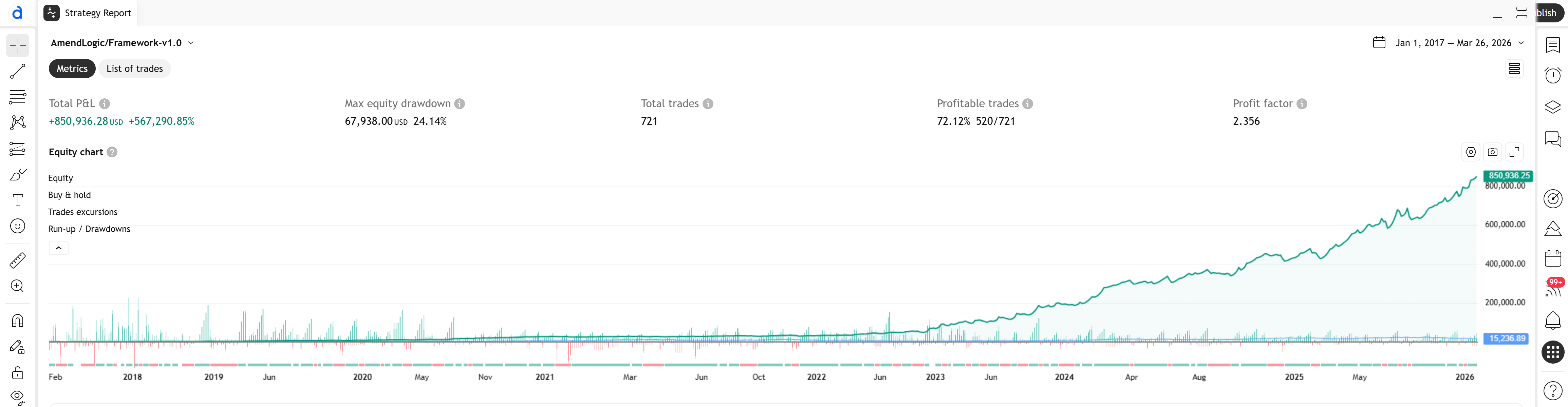
The crypto strategy space is built almost entirely on two things: cherry-picked performance windows and opaque signal logic. A strategy that caught the 2020–2021 bull run looks exceptional in isolation. The same strategy applied through 2022 often tells a completely different story. This framework was stress-tested through drawdown phases, ranging markets, and volatility spikes — not optimized to look good in the one period where everything worked. The goal was a system that survives, not one that dazzles.
The Framework
Transparent Logic. No Black Box.
Every component of the framework is visible inside TradingView. There are no outsourced signals, no proprietary AI claims, no indicators that 'just work' without explanation. The entry logic is derived from price structure. The risk rules are explicit. The execution is deterministic. If you want to understand why a trade was taken, you can trace it step by step.
Entry and exit conditions derived from objective analysis of market structure — expansion, contraction, and transitional phases each treated differently.
Maximum exposure, position sizing, and drawdown thresholds are defined before the market opens — not adjusted mid-trade based on how things feel.
Orders are placed at the moment conditions are confirmed. No waiting for a 'better entry'. No holding past the defined exit because it might turn around.
The framework continuously evaluates whether current market conditions are appropriate for active positioning. When they aren't, it waits — even if waiting is uncomfortable.
Methodology
What the System Actually Measures
The strategy does not predict price. It identifies structural conditions under which historically, the probability of a directional move has been elevated — and sizes exposure accordingly. When those conditions are absent, exposure drops to zero. The frequency of trading is a consequence of market conditions, not a target in itself.
Market Phase Classification
Each market state — trending, ranging, or in transition — requires a different response. The system identifies the current phase and adjusts behavior automatically rather than applying the same rules regardless of context.
Directional Bias Confirmation
A signal in the wrong structural context is noise. The framework only deploys capital when both the signal and the broader market structure are in agreement.
Volatility-Adjusted Exposure
Higher volatility means wider stops and more uncertainty. The framework accounts for this by scaling position size down during elevated volatility — keeping risk-per-trade consistent even as price movement expands.
Risk First
Survival Is the Strategy.
Every losing streak ends eventually. The question is whether your account survives long enough to participate in what comes after. Aggressive drawdowns don't just cost money — they cost the compounding that follows. The framework treats capital preservation not as a secondary consideration but as the primary design constraint. Growth is what happens when you don't blow up.
Fixed Risk Per Trade
Exposure on each trade is calculated from a fixed percentage of account equity. A good-looking setup doesn't get a bigger position — the rule doesn't bend.
Automatic Drawdown Response
During sustained losing periods, the framework reduces activity rather than increasing it. The instinct to 'make it back' is one of the most reliable ways to compound a losing streak — this removes the option.
Volatility-Scaled Sizing
When the market becomes erratic, position sizes contract. This keeps the dollar risk per trade consistent even as price swings widen.
Configurable Boundaries
The core risk parameters — max drawdown threshold, risk per trade percentage, exposure limits — are adjustable to fit your account size and personal tolerance without compromising the underlying system.
Accountability
One Person. Full Responsibility.
AmendLogic...
is built, maintained, and traded by its founder. There is no development team to deflect to, no anonymous signal provider behind the logic, no affiliate network incentivized to oversell the results.
The strategy runs on the same framework that's being sold. Performance is evaluated continuously across live and simulated conditions — not just during the periods that look good in a marketing screenshot.
Selling a rule-based system means standing behind its rules publicly and explicitly. That accountability is not incidental — it's the point.

Understand the System Before You Buy It.
The performance data, methodology, and configuration details are available before you commit to anything. Start with the numbers — then decide.